


Mathematics is filled with symbols, formulas, and shorthand notations that can seem complicated at first glance. One such expression that might look confusing is “sqrd -1/2”. To break this down, let’s first understand what each part means. The term “squad” is commonly used as an abbreviation for “squared,” which means multiplying a number by itself. The “-1/2” is a fraction with a negative exponent. When we combine these two, we get an expression that can be interpreted differently depending on how it is written.
To clarify this concept, let’s explore both possible meanings of “sqrt -1/2” and how to calculate it. We’ll also examine why understanding exponents and squares are essential in mathematics, common mistakes people make when dealing with this notation, and a few practice problems to reinforce the concept.
What Does “sqrd -1/2” Mean?
To fully grasp the meaning of “sqrt -1/2”, we must analyze each component separately.
- “sqrd” (Squared): When a number is squared, it is multiplied by itself. For example, three squared (3^2) means 3 × 3 = 9.
- “-1/2” (Negative Fractional Exponent): The exponent -1/2 tells us to take the reciprocal of the square root of a number.
So, the expression “sqrd -1/2” could mean one of two things:
- Squaring the fraction -1/2: (-1/2) × (-1/2) = 0.25
- Raising a number to the power of -1/2 means taking the reciprocal of the square root of the number. For example, 4^(-1/2) = 1 / √4 = 1 / 2 = 0.5.
Understanding the difference between these interpretations is crucial for solving math problems correctly.
read also: icostamp.com
How to Calculate “sqrd -1/2”
Squaring -1/2
If we take -1/2 and square it, the calculation follows this formula:
(-1/2) × (-1/2) = 0.25
Notice that when a negative number is squared, it becomes positive. This is because multiplying two negative numbers always results in a positive number.
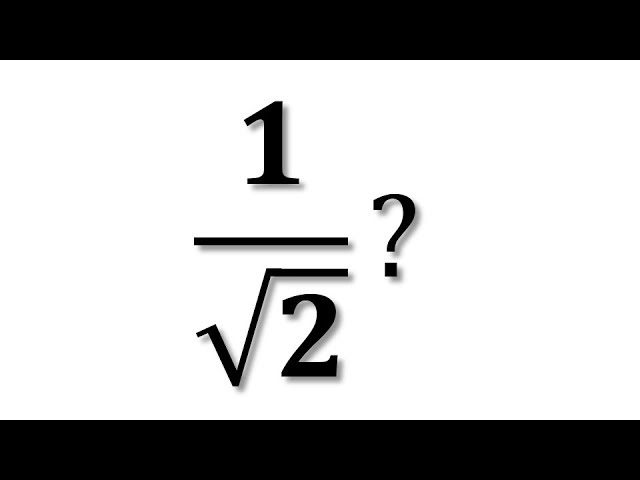
Raising a Number to the Power of -1/2
When we see a number raised to the power of -1/2, we need to follow these steps:
- Take the square root of the number.
- Find the reciprocal of that square root.
For example:
- 4^(-1/2) = 1 / √4 = 1 / 2 = 0.5
- 9^(-1/2) = 1 / √9 = 1 / 3 ≈ 0.333
- 16^(-1/2) = 1 / √16 = 1 / 4 = 0.25
When working with exponents and equations, these calculations are helpful in algebra, physics, and engineering.
Why Is “sqrd -1/2” Important?
Understanding how to work with exponents and square roots is crucial in many areas of math and science. Here’s why:
- Simplifies Complex Equations: Many algebra, calculus, and physics equations use exponents and square roots. Knowing how to manipulate them helps simplify problems.
- Used in Real-World Applications: Concepts like exponential decay, finance (compound interest), and physics (wave equations) often use fractional exponents.
- Builds Strong Math Foundations: Mastering exponents allows students to progress in more advanced topics like logarithms and differential equations.
By understanding expressions like “sqrt -1/2”, we can develop problem-solving skills in mathematics and beyond.
Common Mistakes to Avoid

1. Misinterpreting the Notation
Many people confuse “sqrd -1/2” as just squaring -1/2, but sometimes it refers to raising a number to the power of -1/2. Always check the context of the problem before solving it.
2. Incorrectly Handling Negative Exponents
A negative exponent does not mean the result is negative. Instead, it means taking the reciprocal of the positive exponent. For example:
- 4^(-1/2) is NOT -2.
- The correct answer is 1/2 because 4^(-1/2) = 1 / √4 = 1/2.
3. Forgetting That Squaring a Negative Number Gives a Positive Result
When you square a negative number, the result is always positive:
- (-2)^2 = 4 (NOT -4)
- (-3)^2 = 9 (NOT -9)
Practice Problems
Let’s test our understanding with some practice questions:
- Calculate (3)^(-1/2).
- What is (-2)^2?
- Simplify 16^(-1/2).
Answers:
- (3)^(-1/2) = 1 / √3 ≈ 0.577
- (-2)^2 = 4
- 16^(-1/2) = 1 / √16 = 1 / 4 = 0.25
Practicing these calculations will help reinforce your understanding of exponents and square roots.
The Bottom Line
Mathematics is all about breaking down complex expressions into simpler parts. “sqrd -1/2” might look confusing at first, but once we understand its components, it becomes easy to solve. Whether it means squaring the fraction -1/2 (resulting in 0.25) or raising a number to the power of -1/2 (finding the reciprocal of its square root), knowing how to handle these calculations is essential. Anyone—even a 10-year-old—can quickly grasp these concepts by practicing and avoiding common mistakes.
Understanding exponents and square roots opens doors to more advanced math topics, making calculations more straightforward and intuitive. So next time you see an expression like “sqrt -1/2”, you’ll know exactly what to do!
Find more interesting topics techspare